Category: History

  • What Does “Dap” Mean? The History Behind the Greeting

    What Does “Dap” Mean? The History Behind the Greeting

    What is a dap greeting?

    Dap is a greeting or expression of solidarity that can combine hand and body gestures, including clasps, taps, or other movements. There is no single sequence that covers every dap. Smithsonian accounts document its development among Black service members during the Vietnam War, giving it a history beyond a generic “cool handshake.”

    If you have ever asked whether a dap is the same as a fist bump, the answer is: not necessarily. A fist bump can be one move in a greeting, but the term dap carries cultural history and a wider range of forms. This is where we put down the novelty hand buzzer and pay attention.

    The documented history

    The National Museum of African American History and Culture describes Black service members in Vietnam developing combinations of hand and body gestures as nonverbal communication. The Smithsonian Center for Folklife and Cultural Heritage also discusses the dap as an expression of solidarity among Black soldiers.

    That context matters. This was not just choreography designed to look impressive. The gesture had social meaning in an environment shaped by racial inequality and the pressures of war. Reducing it to “a complicated handshake people do before basketball” erases the reason the history deserves telling.

    Why one universal tutorial would miss the point

    Greetings change across people, places, and relationships. A particular pair may use a familiar clasp and release. Another group may have a longer routine. The presence of variation does not make one person’s greeting fake; it means social gestures are used by actual people rather than printed from one central palm factory.

    The same is true of terminology. If someone describes their greeting as a dap, listen to how they use it. Do not insist that your favorite tutorial defines the only legitimate version.

    How to respond when someone offers a dap

    Watch the offered movement and respond without adding force. If you know the person, follow the routine you have already established. If you do not, keep it simple or ask, “How are we doing this?” A brief clarification is better than pretending you have downloaded the complete handshake expansion pack.

    Do not initiate an elaborate greeting based on someone’s race. Familiarity and the person’s invitation matter. Respectful participation is different from treating a cultural gesture as a costume or proof that you belong to an imagined social category.

    If you are teaching a group about greetings, include the documented history, identify the routine you are demonstrating as one example, and make contact optional. The educational value should survive even if nobody physically performs it.

    Quick answers

    Is dap an acronym?

    You may encounter acronym explanations online. This article does not present one as the settled origin of the word. The documented historical context is firmer ground than an attractive expansion repeated without evidence.

    Is a dap always a secret handshake?

    No. It may be a familiar everyday greeting or a more elaborate shared routine. Its meaning depends on context and the people using it.

    What should I remember most?

    Treat it as a living social gesture with a history. Learn the context, respect the person, and leave the invented origin stories in the same drawer as your fake university diploma from the School of Hard Knocks.

    Sources and viewing notes

    Keep your grip game going

  • The “Friends” Handshake: Decoding Joey & Chandler’s Bromance Grip (and What It Means for You!)

    The “Friends” Handshake: Decoding Joey & Chandler’s Bromance Grip (and What It Means for You!)

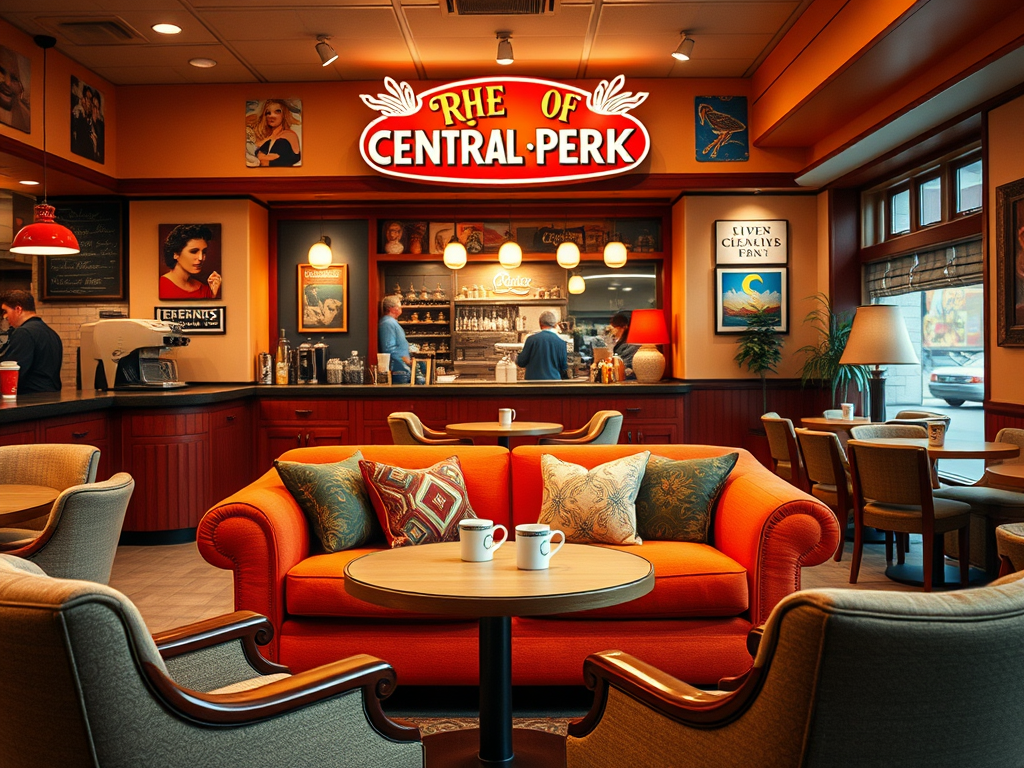
    Alright, pivot, pivot, PIVOT! Today, we’re not just analyzing handshakes; we’re dissecting the very fabric of 90s friendship, specifically through the lens of everyone’s favorite Central Perk regulars: Joey Tribbiani and Chandler Muriel Bing. Their bromance wasn’t just about sharing an apartment, a giant white dog, and a pathological fear of commitment; it was sealed with an intricate, evolving, and often hilarious series of handshakes and non-verbal cues.

    So, grab your oversized coffee mugs, plop down on the orange couch, and let’s uncover what Joey and Chandler’s iconic greeting rituals teach us about establishing rapport, navigating male friendships, and maybe, just maybe, how to snag a free sandwich.

    The “How You Doin’?” Handshake: Effortless Charm and Instant Rapport

    Joey Tribbiani’s signature line, “How you doin’?”, wasn’t just a verbal opener; it often heralded a handshake that perfectly encapsulated his persona. It was warm, confident, and disarmingly friendly, usually accompanied by that famous eyebrow wiggle and a knowing smile. His grip was probably firm but not aggressive, just enough to convey, “Hey, I’m Joey, and I’m probably gonna make you laugh (and maybe hit on your friend).”

    The Chandler Counterpart: Chandler’s handshake, especially early on, would have been a touch more nervous, maybe a slight squeeze of reassurance from Joey as if to say, “It’s okay, man, I’ve got your back (and your sarcastic quips).”

    What it Teaches Us:

    • Authenticity Wins: Joey’s handshake was an extension of his genuine, if sometimes simple, personality. It immediately set a tone of warmth and openness.
    • Reassurance is Key: For someone like Chandler, prone to anxiety, Joey’s steady grip was a non-verbal affirmation of their bond. In networking, a reassuring handshake can calm nerves and build instant trust.

    The “Gum? Gum would be perfection!” Combo: The Escalation of Friendship

    As Joey and Chandler’s friendship deepened, their greetings evolved beyond a simple handshake. This is crucial for understanding long-term rapport. They moved into high-fives, chest bumps (sometimes awkward), and those fantastic, overly elaborate secret handshakes that only make sense if you’ve shared a recliner for a decade.

    Think about the iconic moments: The synchronized arm wrestling. The joint celebrations after a successful “Die Hard” marathon. These aren’t just greetings; they’re affirmations of shared history and mutual understanding. The handshake becomes part of a larger, more intricate “combo move” of friendship.

    The Psychology of the Escalation:

    • Increased Intimacy: Moving from a formal handshake to more varied physical contact (high-fives, playful shoves, even hugs) signifies a deepening of the relationship. It’s a non-verbal way of saying, “We’ve moved beyond mere acquaintances.”
    • Shared Identity: Those secret handshakes? They’re powerful tribal markers. They say, “We’re an ‘us,’ and you’re an ‘them’ (unless you learn the secret code, which you won’t).” This fosters a strong sense of belonging and exclusivity.
    • Comfort and Trust: The ability to engage in playful physical contact without awkwardness is a huge indicator of trust and comfort in a relationship.

    Your Takeaway: In long-term business relationships or team environments, don’t be afraid to let your greetings evolve. A respectful high-five after a project success, or a genuine pat on the back, can solidify rapport beyond the initial handshake. Just know your audience – not every client wants a “pivot!” chest bump.

    The “Seven! Seven! Seven!” Problem: Miscommunication in the Man-Shake

    Even Joey and Chandler, with their unbreakable bond, had their moments of physical miscommunication. Remember the infamous “Seven” gesture? What’s obvious to one isn’t always obvious to the other, leading to comical but relatable awkwardness. This applies directly to handshakes and non-verbal cues in the real world.

    Common Miscommunication Zones:

    • Grip Strength: One person goes firm, the other goes limp. Instant mismatch.
    • Duration: One holds too long, the other pulls away too quickly.
    • The “Pull-In”: One person yanks the other closer, creating a “whoa there, buddy” moment.
    • The “Secret Combo” Fail: When one person attempts a more elaborate greeting (high-five, fist bump, secret handshake) and the other is expecting a simple handshake. It’s like trying to sing “Smelly Cat” and someone else jumps in with “Wonderwall.”

    The Psychology of the Miscommunication: It breaks the rhythm of social interaction, causing a brief moment of cognitive dissonance and sometimes awkwardness. It can make one or both parties feel slightly uncomfortable or misunderstood.

    Your Takeaway: Observe and adapt. Be present enough to read the other person’s cues. If you’re going for something beyond a standard handshake, make sure the other person looks receptive. When in doubt, default to the universally understood firm-but-friendly standard. And if a miscommunication happens, just laugh it off, like Chandler’s quick wit diffusing a tense situation.

    The “Could I BE Any Closer?” Boundary Push: Respecting Personal Space

    While Joey and Chandler were practically glued at the hip, they still had their boundaries (mostly). The handshake, especially in a professional setting, involves respecting personal space. A handshake that pulls you too close, or lingers uncomfortably, can break rapport rather than build it.

    The Joey/Chandler Lesson: Even in a close friendship, there’s an unspoken respect for personal bubbles. Joey knew when to hit on someone’s date, and when to back off (usually).

    Your Takeaway: A handshake should bring you together physically for a moment, but not invade personal space. Maintain a comfortable arm’s length, engage for 2-3 seconds, and then release. It’s a greeting, not a wrestling match (unless that’s your secret friendship combo, in which case, you do you).

    Conclusion: “Pivot!” Towards Better Handshakes

    The bromance between Joey and Chandler was a masterclass in evolving male friendship, built on humor, shared experiences, and a surprisingly insightful array of non-verbal cues. Their handshakes, from the initial “How you doin’?” to the elaborate combo moves, reflect the journey of rapport and trust.

    So, next time you extend your hand, think about Joey’s effortless charm, Chandler’s underlying warmth, and their combined ability to navigate awkwardness with a laugh. Make your handshake an affirmation of connection, a subtle nod to shared humanity, and maybe, just maybe, the start of your own iconic professional bromance (or womance, or just good ol’ productive work alliance). Now, could I be any clearer?

  • The Handshake’s Subtle Sexism: Unpacking Gender Dynamics in a Simple Greeting

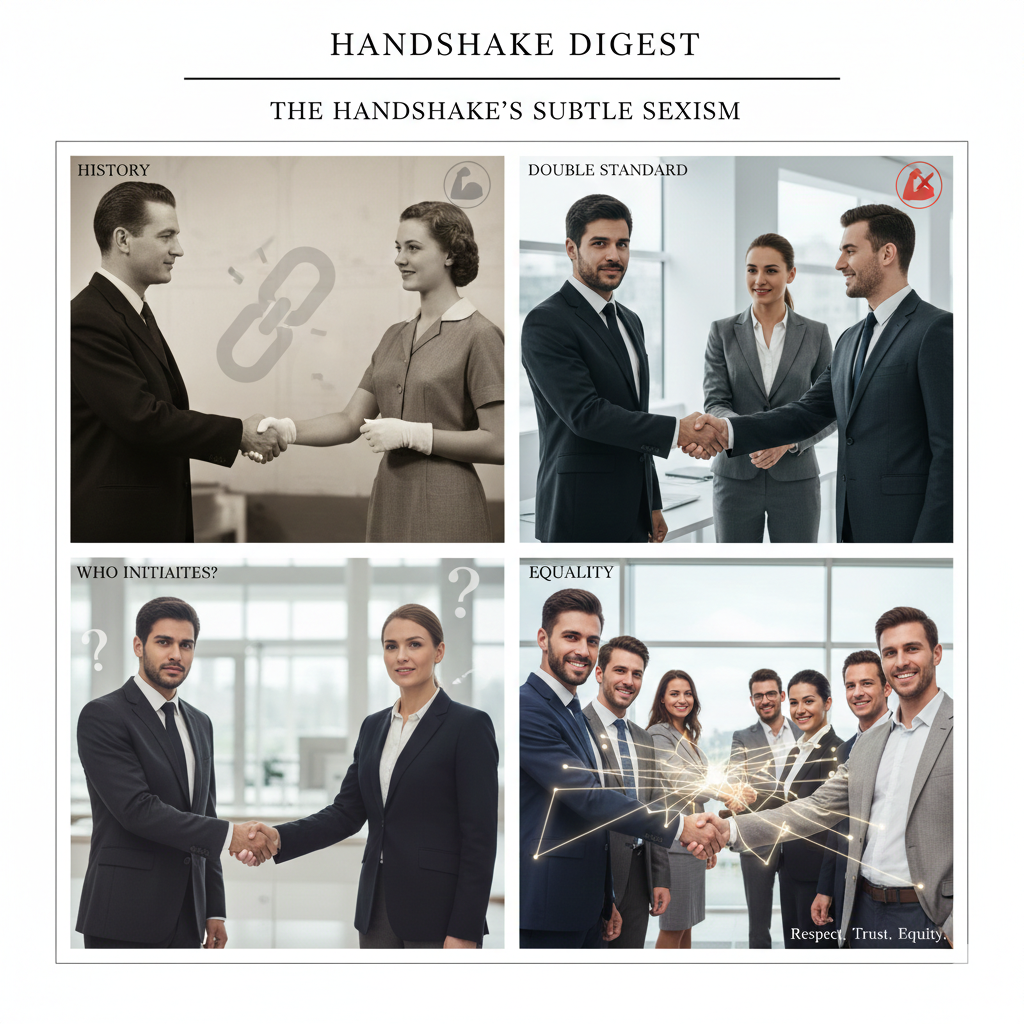
    The Handshake’s Subtle Sexism: Unpacking Gender Dynamics in a Simple Greeting

    For centuries, the handshake has been a powerful social and professional gesture, a non-verbal contract sealing everything from business deals to casual acquaintanceships. Yet, despite its seemingly neutral mechanics, the handshake is far from immune to the subtle—and sometimes not so subtle—influences of gender dynamics. From expectations around grip strength to who initiates the contact, gender can, and often does, play a significant role in how handshakes are perceived and performed.

    This isn’t about blaming individuals, but rather understanding ingrained societal biases and historical norms that continue to shape even the simplest of interactions. Unpacking the “handshake’s subtle sexism” means recognizing these dynamics and advocating for an equitable greeting experience for everyone.

    The “Lady’s Handshake”: A Relic of the Past?

    Historically, women were often offered a much lighter, almost delicate handshake, sometimes referred to as a “lady’s handshake.” This stemmed from outdated notions of female fragility and a desire to avoid appearing overly aggressive or unladylike. Men were implicitly (and sometimes explicitly) taught to adjust their grip when shaking a woman’s hand, often resulting in a less firm, almost dismissive interaction for the woman.

    What this communicates (unintentionally or intentionally):

    • Patronization: It can feel condescending, implying a woman is not capable of or deserving of a “real” handshake.
    • Weakness: It subtly reinforces stereotypes of female weakness or lack of assertiveness.
    • Disrespect: In a professional context, a noticeably weaker handshake can undermine a woman’s credibility or signal a lack of seriousness from the other party.

    While thankfully less prevalent today, the echoes of the “lady’s handshake” can still be felt. Women might still occasionally receive a weaker grip from men, or, conversely, feel pressured to overcompensate with an overly firm grip to avoid being seen as weak.

    The Double Standard of Grip Strength

    One of the most persistent gendered aspects of handshakes is the expectation surrounding grip strength.

    • For Men: A firm, confident handshake is almost universally expected and celebrated. It signals strength, confidence, and professionalism. A weak handshake from a man is often quickly judged negatively.
    • For Women: The expectation is more ambiguous. While a firm handshake is increasingly seen as professional and empowering for women, there is sometimes a narrower margin for error. An overly firm handshake from a woman might still, by some, be misconstrued as aggressive or unfeminine, whereas the same grip from a man would simply be seen as strong. Conversely, a weak handshake from a woman might be dismissed more readily than from a man.

    This double standard puts women in a tricky position: aiming for the “just right” firmness that conveys competence without crossing an invisible line into perceived aggression. This can add an unnecessary layer of self-consciousness to an otherwise simple gesture.

    Who Initiates? The Lingering Question of Protocol

    Historically, social etiquette often dictated that men should wait for women to extend their hand first. This was rooted in chivalry but also in a framework where women’s agency in social interactions was more circumscribed.

    While modern professional etiquette largely dictates that whoever initiates the greeting (regardless of gender) can initiate the handshake, some lingering uncertainty persists, particularly in more traditional or formal settings.

    • For Men: There can be a slight hesitation when greeting a woman, a subconscious pause to avoid appearing overly forward or disrespectful if she prefers not to shake hands.
    • For Women: There might be moments where extending a hand proactively feels like a bolder move than it should, or a subtle expectation that men should offer first still exists from some.

    In professional environments, this dynamic can lead to missed opportunities for immediate connection or contribute to an awkward start if both parties are waiting for the other to make the first move.

    The Impact on Professional Perception

    The cumulative effect of these gender dynamics is not trivial. In professional settings, where first impressions are critical:

    • Women can be subtly disadvantaged if their handshake is perceived as too weak (reinforcing stereotypes) or too strong (violating unspoken norms).
    • Men might unintentionally undermine a woman’s authority by offering a lighter grip or hesitating to initiate.

    These subtle signals contribute to the overall perception of competence, confidence, and leadership, which can have real-world implications for career advancement, negotiation outcomes, and professional relationships.

    Towards Equitable Handshakes: Best Practices for Everyone

    Achieving gender-neutral handshake etiquette isn’t about ignoring gender, but rather transcending outdated norms to create an equitable and respectful experience for all.

    1. Acknowledge and Challenge Biases: Be aware of your own potential subconscious biases. Are you subconsciously adjusting your grip based on gender? If so, challenge that instinct.
    2. Aim for Consistency: The “ideal” handshake—firm, full-hand grip, direct eye contact (where culturally appropriate), and a genuine smile—should be the standard for everyone, regardless of gender.
    3. Initiate Confidently (When Appropriate): Whether you are a man or a woman, if you are initiating a professional greeting, feel confident in extending your hand. The person who is initiating the introduction is generally the one to offer the handshake.
    4. Focus on Connection, Not Gender: Shift your mindset from “shaking a man’s hand” or “shaking a woman’s hand” to “shaking a person’s hand.” The goal is mutual respect and connection.
    5. Observe and Adapt to the Individual: While general guidelines are helpful, ultimately, you are interacting with an individual. Be sensitive to their cues and adjust if necessary, but don’t let gender be the primary determinant of your approach.

    The handshake, in its purest form, is a powerful symbol of equality and mutual respect. By actively challenging historical gender biases and embracing a consistent, confident approach, we can help ensure that this foundational greeting truly reflects the modern values of professionalism and fairness for all. The goal is simple: for every handshake to be a genuine moment of connection, free from the subtle constraints of outdated gender expectations.

  • The “Limp Fish” to the “Bone Crusher”: Deconstructing the Bad Handshake and How to Fix It

    The “Limp Fish” to the “Bone Crusher”: Deconstructing the Bad Handshake and How to Fix It

    The handshake. It’s a fundamental human greeting, a non-verbal contract, and often the very first impression we make. We’ve all experienced the good ones – firm, confident, and reassuring. But we’ve also endured the bad ones, those awkward encounters that leave a lingering sense of unease or even outright judgment. From the notoriously off-putting “limp fish” to the intimidating “bone crusher,” a poor handshake can unwittingly communicate disinterest, aggression, or a lack of confidence. Understanding these common missteps and knowing how to correct them is crucial for anyone looking to make a positive impact in social and professional settings.

    The Limp Fish: A Drowning Impression

    Perhaps the most universally loathed handshake is the “limp fish.” This is where the giver offers a hand devoid of tension, a soft, clammy, and unengaging grip that feels more like holding a lifeless object than connecting with another human being.

    What it communicates:

    • Disinterest: It suggests a lack of enthusiasm or a desire to avoid interaction.
    • Lack of Confidence: It can be interpreted as shyness, insecurity, or even submissiveness.
    • Weakness: In a business context, it might imply a lack of conviction or resolve.
    • Germ Aversion: Sometimes, it’s mistaken for a subtle attempt to minimize contact due to a fear of germs, which can feel insulting.

    Why it happens: Often, a limp fish handshake isn’t intentional. It might stem from shyness, social anxiety, or simply never having been taught the importance of a firm grip. Some individuals might also misinterpret “gentle” as “polite,” especially in cultures where overly firm grips are seen as aggressive.

    How to fix it: The remedy for a limp fish is straightforward: conscious effort and a slight increase in firmness.

    • Focus on the Web: When approaching for a handshake, aim to meet the web of your hand (the space between your thumb and forefinger) with the web of the other person’s hand. This ensures a full, proper grip.
    • Apply Gentle Pressure: Imagine you’re gently squeezing a ripe orange – firm enough to feel, but not so hard as to crush it. This provides a sense of connection without aggression.
    • Engage Your Hand: Don’t just offer your fingers; engage your entire hand and arm in the motion.

    The Bone Crusher: An Act of Unintended Aggression

    On the opposite end of the spectrum is the “bone crusher” or “vice grip.” This handshake is characterized by excessive force, often accompanied by a competitive squeeze that can genuinely cause discomfort or even pain.

    What it communicates:

    • Aggression/Dominance: It’s often perceived as an attempt to assert superiority or intimidate.
    • Lack of Awareness: The giver might be completely oblivious to the pain they’re inflicting, signaling a lack of empathy or social awareness.
    • Overcompensation: Sometimes, it’s an overcorrection for a previously weak handshake, or an attempt to appear “stronger” than one feels.

    Why it happens: Many bone crushers are well-intentioned but misguided. They might have been told to have a “firm handshake” and overdo it, or they might be genuinely unaware of their own strength. In some competitive environments, it can be a deliberate (though often counterproductive) power play.

    How to fix it: The key here is moderation and sensitivity.

    • Mirror the Pressure: When you shake hands, be aware of the pressure the other person is applying. Aim to match it, or be slightly firmer if their grip is too weak.
    • Focus on Connection, Not Strength: Remind yourself that the goal is to create a connection, not to demonstrate physical prowess.
    • Practice with Awareness: If you know you tend to be a bone crusher, consciously reduce your force and ask a trusted friend for feedback.

    The Sweaty Palm: An Unfortunate Reality

    While not a “type” of handshake in terms of grip, a sweaty palm can derail an otherwise perfect greeting. It’s often involuntary and can be a source of anxiety for the person experiencing it.

    What it communicates:

    • Nervousness: Often associated with anxiety or stress.
    • Discomfort: Can make the other person feel uncomfortable or even repulsed.

    How to manage it:

    • Subtle Wipe: Before an important meeting or greeting, discreetly wipe your palm on your pants or skirt.
    • Hand Sanitizer (with caution): Alcohol-based hand sanitizers can temporarily dry the skin, but use sparingly to avoid leaving a sticky residue.
    • Keep Hands Free: Avoid holding a cold drink that might condense and make your hands colder and wetter.

    The Hover Hand / Air Handshake: The Awkward Avoidance

    In the age of heightened germ awareness, some people attempt an “air handshake” or a “hover hand,” where they extend a hand but don’t quite make contact, or perform a very light, fleeting touch.

    What it communicates:

    • Germophobia: A clear signal of a desire to avoid physical contact.
    • Social Awkwardness: Can leave the other person feeling confused or rejected.
    • Lack of Sincerity: The absence of a real grip can make the greeting feel insincere.

    How to fix it: If you’re genuinely concerned about germs, it’s usually better to offer a clear alternative rather than an awkward half-handshake. A verbal “It’s wonderful to meet you, but I’m just getting over a cold, so I’ll offer you a nod instead!” is far more polite and less ambiguous than a hover. If no health concerns exist, commit to a proper handshake.

    The Importance of the Complete Package: Eye Contact and Verbal Greeting

    Remember, a handshake isn’t just about the grip. It’s part of a larger interaction:

    • Eye Contact: Direct, friendly eye contact is crucial. It conveys honesty, sincerity, and engagement. Avoid staring, but hold contact for the duration of the handshake.
    • Genuine Smile: A warm, authentic smile makes you approachable and reinforces a positive impression.
    • Verbal Greeting: A clear “Nice to meet you,” “Hello,” or “Good morning” completes the interaction and adds a layer of professionalism and warmth.

    Practice Makes Perfect

    Like any skill, mastering the handshake takes practice. Pay attention to how others shake hands, and consciously evaluate your own technique. Ask trusted friends or mentors for honest feedback. By avoiding the pitfalls of the limp fish and the bone crusher, and by focusing on a confident, respectful, and culturally appropriate grip, you can transform your handshake into a powerful tool for building connections and making memorable first impressions.

  • The Definitive Ranking of the Top 25 Animal Handshakes

    The Definitive Ranking of the Top 25 Animal Handshakes

    Here is the definitive ranking of animals, from the “barely trying” to the “virtually human.”

    We often talk about the firm squeeze of a CEO or the limp-fish flop of a disinterested nephew, but today we are looking beyond our species. The animal kingdom is full of graspers, clutchers, and claspers. But who can actually shake hands like a human? We analyzed 25 candidates based on three key metrics: Thumb Opposability (TO), Grip Dexterity (GD), and Social Willingness (SW).

    Here is the definitive ranking of animals, from the “barely trying” to the “virtually human.”


    Tier 5: The “Technically It’s a Limb” Category

    25. The American Lobster

    • The Shake: “The Vice Grip”
    • Verdict: Terrifying. While the lobster technically offers a pincer that resembles an outstretched hand, the lack of fingers and the presence of crushing hydraulic pressure make this a handshake to avoid. It’s less “Nice to meet you” and more “I am removing your thumb.”

    24. Tyrannosaurus Rex

    • The Shake: “The Ghost”
    • Verdict: Included for historical context. The T-Rex had the spirit, but the biomechanics were tragic. The arms were too short to bridge the social distance required for a formal introduction. A handshake that ends before it begins.

    23. The Octopus

    • The Shake: “The Clinger”
    • Verdict: Too enthusiastic. A handshake requires a release; the octopus doesn’t understand this. With hundreds of suckers and no bones, the texture is all wrong—slimy, cold, and clingy. Plus, shaking one arm often implies consent to shake the other seven.

    22. The Chameleon

    • The Shake: “The Pincer”
    • Verdict: Chameleons possess zygodactylous feet (two toes forward, two back), creating a clamp-like grip. However, they move in slow, shuddering steps and usually mistake your finger for a branch. Zero eye contact.

    21. The Parrot

    • The Shake: “The Footer”
    • Verdict: Birds like Macaws and Cockatoos are highly intelligent and often lift a foot to greet owners. While charming, shaking a foot while the other party is standing is a breach of etiquette. The talons also tend to pierce the skin, ruining the diplomatic effect.

    Tier 4: The Reluctant & The Confused

    20. The Squirrel

    • The Shake: “The Jitterbug”
    • Verdict: Squirrels have surprisingly dexterous little hands for manipulating acorns. However, their grip is frantic and scratchy. They treat your hand less like a partner and more like a tree bark surface to be scaled.

    19. The Three-Toed Sloth

    • The Shake: “The Slow-Mo”
    • Verdict: By the time the sloth has raised its arm to meet yours, the networking event is over. Their long, curved claws act as hooks rather than grippers. They don’t squeeze; they just hang there.

    18. The Opossum

    • The Shake: “The Reverse Thumb”
    • Verdict: North America’s only marsupial has an opposable thumb (hallux)—but it’s on their hind feet. Trying to shake hands with an opossum involves an awkward leg lift that looks more like a yoga pose than a greeting.

    17. The Kangaroo

    • The Shake: “The Boxer”
    • Verdict: Kangaroos have five-fingered hands that are great for grappling. The problem is they usually use this grip to hold you in place while they kick you in the ribs. A firm grip, but the hostility score is too high.

    16. The Domestic Cat

    • The Shake: “The Dead Fish”
    • Verdict: Can a cat shake hands? Yes. Will it? Only if there is a high-value treat involved, and even then, the “shake” is a limp, disdainful tap on your palm. It is the handshake of a monarch dismissing a peasant.

    Tier 3: The Honorable Mentions

    15. The Polydactyl Cat

    • The Shake: “The Mitten”
    • Verdict: Ranking slightly higher than standard cats due to the “Ernest Hemingway” gene. These cats possess extra toes, giving their paws a broad, baseball-glove appearance that feels surprisingly substantial in the hand. Still suffers from the classic feline attitude problem.

    14. The Grizzly Bear

    • The Shake: “The High Five”
    • Verdict: Bears have plantigrade paws (walking flat-footed like humans) and can rotate their forearms. Circus history proves they can learn the gesture. However, without a true opposable thumb, it’s just a flat slab of meat. Also, the risk of mauled shoulders keeps them out of the top 10.

    13. The Sea Otter

    • The Shake: “The Holder”
    • Verdict: Sea otters hold hands while sleeping to stop drifting apart. This is arguably the purest form of hand-holding in nature. However, for a business handshake, it’s too intimate. Plus, they keep rocks in their armpits.

    12. The Giant Panda

    • The Shake: “The False Thumb”
    • Verdict: Pandas have a unique sesamoid bone in their wrist that acts as a “false thumb” for gripping bamboo. It works for eating, but in a handshake, it feels bony and rigid. A clumsy greeter.

    11. The Spider Monkey

    • The Shake: “The Hook”
    • Verdict: Evolutionarily, the Spider Monkey lost its thumb to swing better through trees. Their hand is four long fingers forming a meat-hook. You can shake it, but you can’t lock it. It feels unfinished.

    Tier 2: The Contenders

    10. The Raccoon

    • The Shake: “The Sensory Wash”
    • Verdict: Raccoons lack thumbs but make up for it with hypersensitive palms. They have 5x more mechanoreceptors in their hands than most mammals. Shaking hands with a raccoon is a tactile experience; they will feel every ridge of your fingerprint. The downside? Their hands are often wet because they douse everything in water.

    9. The Capuchin

    • The Shake: “The Hustler”
    • Verdict: The classic “organ grinder” monkey. They have thumbs (though not fully opposable in the human sense) and high dexterity. They understand the exchange. However, their handshake often feels transactional, like they are checking for a coin in your palm.

    8. The Baboon

    • The Shake: “The Politician”
    • Verdict: Baboons have some of the best opposable thumbs outside of the great apes. Their precision grip is elite. However, a baboon handshake is often accompanied by a baring of teeth and intense eye contact that signals dominance. A very aggressive networker.

    7. The Orangutan

    • The Shake: “The Leather Glove”
    • Verdict: With four long fingers and a short thumb, the Orangutan’s hand is designed for hooking branches. Their grip strength is roughly 5-7 times that of a human. The skin is leathery and dry. It’s a slow, powerful shake that commands respect, though the short thumb makes the “lock” difficult.

    6. The Gorilla

    • The Shake: “The Crusher”
    • Verdict: The Gorilla hand is massive, with short, thick fingers. It’s like shaking a catcher’s mitt made of granite. The thumb is opposable but relatively small compared to the massive palm. A Gorilla handshake is a life-changing event that requires you to be very submissive unless you want your radius bone snapped.

    Tier 1: The Handshake Elite

    5. The Koala

    • The Shake: “The Double-Clutch”
    • Verdict: The Koala is the dark horse of this list. Why? Two opposable thumbs on each hand. That is not a typo. The Koala’s hand consists of two thumbs and three fingers, allowing for a pincer-like grip that is biologically superior for grasping branches—and hands. It is the most secure grip in the animal kingdom. If a Koala shakes your hand, you are shook.

    4. The Border Collie (representing all Dogs)

    • The Shake: “The Good Boy”
    • Verdict: Anatomically, dogs are a disaster—no thumbs, just toes and pads. But functionally? They are the masters. We have bred them for thousands of years to perform this specific trick. The enthusiasm, the paw placement, the eye contact—the Dog Shake scores a 10/10 for Social Willingness, even if the Grip Mechanics are a 2/10.

    3. The Bonobo

    • The Shake: “The Empath”
    • Verdict: Bonobos are our closest relatives (alongside chimps) but are far less aggressive. A Bonobo handshake is gentle, warm, and eerily human. Their hands are long and slender. The only risk is that Bonobos use handshakes (and other touches) to resolve all conflicts, so the handshake might linger a little too long and become… awkward.

    2. The Chimpanzee

    • The Shake: “The Mirror”
    • Verdict: The gold standard of non-human gripping. The Chimpanzee hand is nearly identical to a human’s, albeit with a shorter thumb and longer palm. They use tools, they groom, and they grasp with intent. A chimp’s handshake conveys strength, texture, and temperature that is 99% human. It is the Uncanny Valley of handshakes.

    1. The Human

    • The Shake: “The Original”
    • Verdict: We tried to find a champion in the wild, but after reviewing 24 other species, we must concede the title. The human hand, with its long, fully opposable thumb and distinct muscle control, was evolutionarily designed for this exact gesture. No other animal can execute the “squeeze, pump, release” with the same level of nuance. We are the kings of the shake.

    Don’t agree with our rankings? Reach out to us (with an open palm) in the comments below.

  • The 10 Most Important Handshakes in Human History

    The 10 Most Important Handshakes in Human History

    The simple act of extending a hand is one of our most ancient and enduring gestures. While it began as a way to prove one wasn’t carrying a weapon, the handshake has evolved into a profound symbol of trust, reconciliation, and the forging of new eras.

    In a world often defined by complex treaties and digital signatures, these ten moments prove that a single physical connection can change the course of human history.

    10. King Shalmaneser III and King Marduk-Zakir-Shumi I (9th Century BC)

    The oldest “recorded” handshake in history isn’t found in a photograph, but on a stone relief. Discovered in modern-day Iraq, this ancient carving depicts the Assyrian King Shalmaneser III clasping the hand of the Babylonian King Marduk-zakir-shumi I to seal an alliance. It is the first tangible evidence we have that humans have used this gesture to bridge political divides for nearly 3,000 years.

    9. Ulysses S. Grant and Robert E. Lee (1865)

    The climax of the American Civil War was defined by a quiet moment in a parlor at Appomattox Court House. While the formal surrender was written on paper, it was the civil, respectful handshake between the two generals that signaled the beginning of a long, painful healing process for a fractured nation.

    8. The Apollo-Soyuz Handshake (1975)

    At the height of the Cold War, two rival superpowers met in the most unlikely of places: low Earth orbit. When American astronaut Thomas Stafford and Soviet cosmonaut Alexei Leonov opened their respective hatches and shook hands through the docking module, it signaled that even the vastness of space could be a place of cooperation rather than conflict.

    7. Queen Elizabeth II and Martin McGuinness (2012)

    This was a handshake many thought would never happen. Martin McGuinness, a former IRA commander, and Queen Elizabeth II, the monarch whose cousin had been killed by an IRA bomb, met in Belfast to shake hands. It was a staggering display of “the politics of the possible,” helping to solidify the peace process in Northern Ireland through sheer symbolic grace.

    6. Kim Jong-un and Moon Jae-in (2018)

    In a moment that captivated the globe, the leaders of North and South Korea met at the Military Demarcation Line. They didn’t just shake hands; they stepped across the concrete border together. While long-term peace remains elusive, the image of these two men holding hands across a line that had been a scar for 65 years was a powerful reminder of shared heritage.

    5. Anwar Sadat and Menachem Begin (1977)

    When Egyptian President Anwar Sadat traveled to Jerusalem to meet Israeli Prime Minister Menachem Begin, it was a move of incredible personal and political bravery. Their handshake, later formalized at the Camp David Accords, led to the first-ever peace treaty between Israel and an Arab neighbor—a feat that earned both men the Nobel Peace Prize.

    4. Richard Nixon and Mao Zedong (1972)

    For over two decades, the United States and the People’s Republic of China were locked in a diplomatic deep freeze. Nixon’s visit to Beijing changed everything. His handshake with Chairman Mao was the physical manifestation of “the week that changed the world,” realigning global power structures and opening the door to the modern global economy.

    3. Nelson Mandela and F.W. de Klerk (1990)

    As Nelson Mandela walked out of Victor Verster Prison after 27 years, he didn’t emerge with a fist of vengeance, but an open hand. His subsequent handshake with President F.W. de Klerk signaled the dismantling of Apartheid. It was the moment the world realized that South Africa was moving toward a “Rainbow Nation” rather than a civil war.

    2. Ronald Reagan and Mikhail Gorbachev (1985)

    When these two leaders met for the first time in Geneva, the world was on the brink of nuclear catastrophe. Their initial handshake, captured by hundreds of cameras, was the first thaw in a decades-long winter. It set the stage for the INF Treaty and the eventual peaceful end of the Soviet Union, effectively concluding the Cold War.

    1. Yitzhak Rabin and Yasser Arafat (1993)

    On the South Lawn of the White House, with President Bill Clinton standing behind them with arms outstretched, Israeli Prime Minister Yitzhak Rabin and PLO Chairman Yasser Arafat reached out and shook hands. It was a moment of profound hope that felt, at the time, like the impossible becoming possible. Though the peace process later faced tragic setbacks, this remains the most iconic handshake in modern history—a testament to the idea that even the most bitter enemies can choose to touch palms and try for peace.

  • The Etymological Grip

    The Etymological Grip

    A History of the Handshake in Literature and Culture

    The simple clasp of two hands—a universally recognized gesture of greeting, agreement, and farewell—is one of humanity’s oldest rituals. Yet, the word we use to name this ritual, “handshake,” is surprisingly modern. Its first appearance as a compound noun in literary works dates back to the very cusp of the 19th century, specifically the year 1801. This late coinage in English literature marks an interesting cultural moment: the point at which a gesture practiced for millennia became a distinct, formal noun.

    From Gesture to Noun: A Late Arrival

    While the noun “handshake” only emerged in 1801, its root phrase, “to shake hands,” has a far deeper literary pedigree. The action of “shaking hands” to signify agreement, amity, or resolution was already a familiar concept in the 16th century, finding its way into the works of literary giants.

    Perhaps the most famous example comes from William Shakespeare, who wrote in As You Like It (c. 1599) of a reconciliation where two quarreling parties “shook hands and swore brothers.” Similarly, a 1594 sonnet by Michael Drayton includes the line, “Since there’s no help, come let us kiss and part,” which invites the parting lovers to “shake hands for ever, cancel all our vows.” In these contexts, the phrase denoted a dramatic sealing of a bargain or the final termination of an affair—a profound, non-verbal signature.

    The adoption of the shorter, punchier noun “handshake” in 1801 suggests a key shift. The action had become so common, so integrated into everyday social life—especially as a standard greeting—that it required a dedicated title. It was no longer just an action to seal a momentous vow; it was an established ritual for any quotidian encounter.

    The Deep Roots: From Homer to Quakers

    The concept of the handshake, often called dexiosis (meaning “joining of the right hands”) by the ancient Greeks, predates the English word by thousands of years.

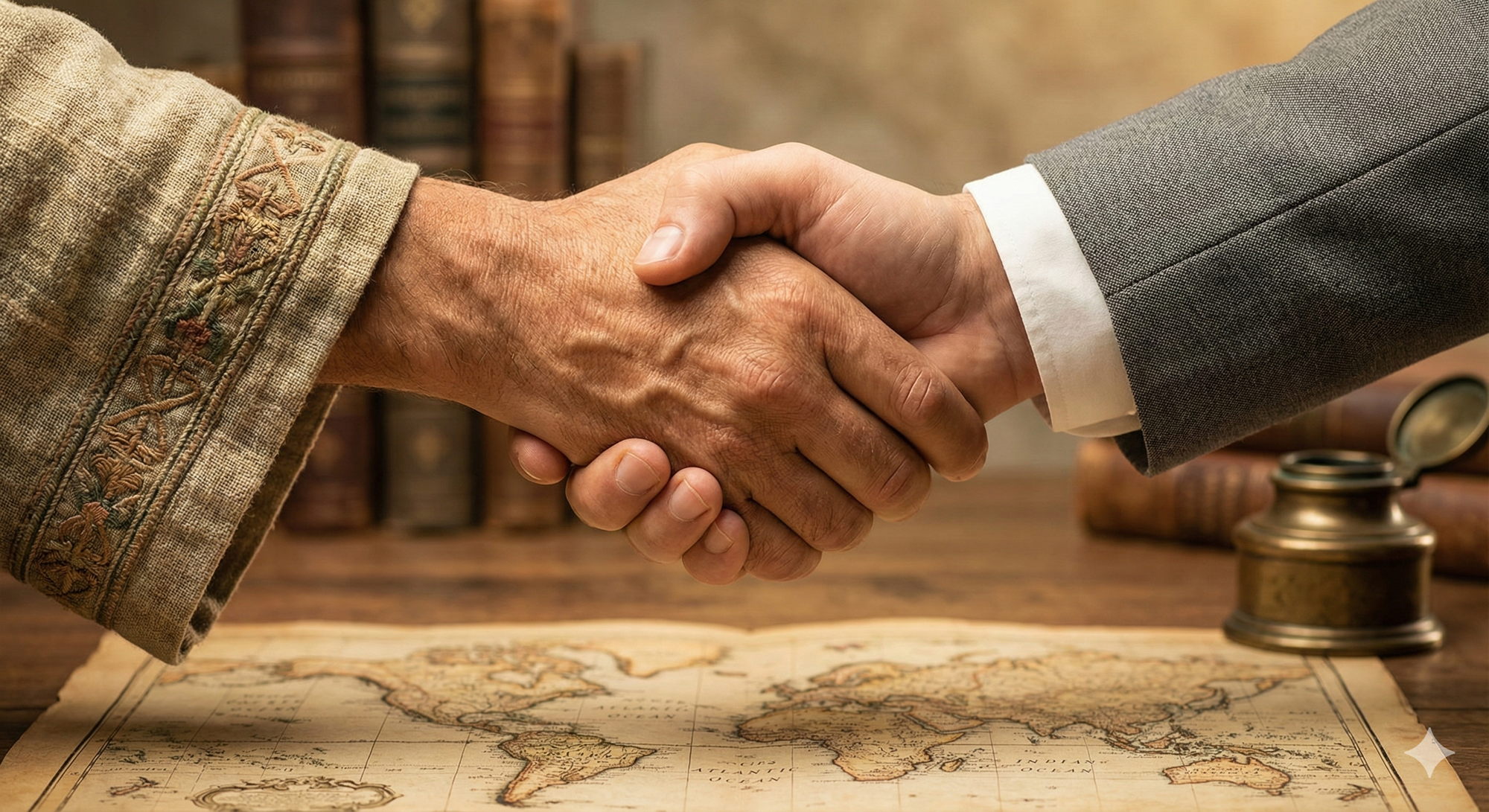
    • Ancient Pledges: The epic poet Homer frequently described characters grasping hands in the Iliad and the Odyssey to demonstrate trust and make pledges. An ancient Assyrian relief from the 9th century B.C. even depicts King Shalmaneser III clasping the hand of a Babylonian ruler to seal a treaty. In these early instances, the gesture was primarily one of alliance and peace, a way for two armed men to show they held no weapons.
    • The Ritual of Farewell: In 4th and 5th-century B.C. Greek funerary art, the handshake was a recurring motif on gravestones, symbolizing the eternal bond between the living and the deceased or a final, peaceful farewell.
    • Egalitarianism and the Quakers: The gesture experienced a strong cultural resurgence in the 17th century, popularized by groups like the Quakers in Britain. They favored the simple, unpretentious handclasp as an egalitarian alternative to the highly hierarchical rituals of bowing, curtsying, and hat-tipping, which signified social rank. By extending the handshake to everyone regardless of station, the gesture was imbued with a democratic, anti-establishment spirit.

    The Victorian Etiquette Wars

    The 19th century, the era immediately following the coining of “handshake,” was when the ritual truly diffused across all classes and became the standard greeting we know today. However, this popularization wasn’t without controversy.

    As the handshake spread, etiquette manuals began to emerge, often debating the proper way to execute it. In the high society of Victorian Britain, the handshake was sometimes looked down upon as a vulgar, overly familiar “English innovation”—especially by travelers who observed its rampant use in the republican, less-formal United States.

    Gender complicated the matter, too. For a time, it was considered improper for a man to initiate a handshake with a woman; the lady had to offer her hand first—a final, formal remnant of the gesture’s earlier, more ritualized uses, battling the democratic spirit the Quakers had instilled.

    The Handshake in the Modern Era: A Barometer of Society

    The 19th and 20th centuries solidified the handshake as the ultimate social and professional shorthand. By the time the world entered the era of global commerce and diplomacy, the quality of the handshake became a subject of intense scrutiny, particularly in American culture.

    Psychologists, business coaches, and self-help gurus began dissecting the perfect grip. The “dead fish” (a limp, cold hand) was universally condemned as a sign of weakness or apathy, while the “bone crusher” (an overly aggressive grip) was seen as a dominant or even hostile display. The ideal became the “firm, dry clasp”—a signal of confidence, honesty, and professional respect. The handshake evolved from a mere transactional gesture (sealing a peace treaty or a farewell) into a crucial tool of personal branding.

    In literature and film, the handshake became a powerful narrative device. A hesitant handshake could signify distrust; a refusal to shake hands, a deep, irreconcilable animosity. It provided a moment of high tension or immediate reconciliation, allowing the audience to gauge the true power dynamics between characters without a single word being spoken. The silent, almost cinematic language of the gesture—now formally enshrined as the noun “handshake” since 1801—had become fully integrated into our storytelling toolkit.

    The 21st Century Disruption

    For over 200 years, the formal “handshake” remained almost unchallenged as the default greeting in Western society. However, the 21st century has introduced significant friction into this ancient ritual.

    The rise of digital communication first began to challenge in-person contact, making the firm clasp feel almost anachronistic in a world of casual text messages and remote work. But the true, unprecedented disruption came in 2020 with the global pandemic. Health concerns suddenly transformed the simple, friendly gesture into a potential vector for contagion. Public health authorities worldwide advised against shaking hands, resulting in a rapid shift toward alternative greetings: the elbow bump, the fist bump, the “namaste” bow, or simply a friendly wave.

    This global pause forced a profound cultural reflection. Did we truly need the handshake? Was it worth the risk? While many returned to the handshake as the public health crisis subsided, the debate remains, and a lingering reluctance in certain social settings persists. The handshake is no longer an automatic, thoughtless gesture; it is now a deliberate choice, often requiring a momentary non-verbal negotiation between two people.

    The Complete Story of the Grip

    From the ancient Assyrian relief depicting a diplomatic agreement to the Quaker meeting house where it symbolized radical equality, and finally, to the modern dilemma of viral transmission, the joining of hands has always been more than just a greeting.

    The history of the handshake is the story of human civilization’s need for verifiable trust. It started as a practical demonstration of peace—I carry no weapon. It evolved into a legal and social sign-off—I agree to this vow. And finally, when the action became so standard it needed a name, the word “handshake” was coined in 1801, cementing its status as the social default.

    Today, whether you offer a firm handshake or opt for a simple wave, you are participating in a conversation that spans thousands of years. The grip may change, and its necessity may be debated, but its function remains vital: it is a non-verbal compact, a momentary meeting of two individuals acknowledging mutual presence and respect. The power of the handshake, whether literary or literal, endures, silently binding us to the long, rich history of human connection.

  • The Grip of History

    The Grip of History

    Unpacking the Origin of the Word Handshake

    It’s one of the most fundamental human gestures. From sealing a business deal to greeting a long-lost friend, the handshake is a universal symbol of agreement, respect, and camaraderie. But have you ever stopped to consider where this seemingly simple act, and the word we use to describe it, actually comes from? Delving into the etymology of “handshake” takes us on a fascinating journey through ancient customs, evolving social norms, and the very fabric of human interaction.

    The act of clasping hands has roots that stretch back millennia. Archaeological evidence and ancient texts suggest that this gesture was common in many early civilizations. For instance, Egyptian tomb paintings depict figures grasping hands, often in a show of fidelity or as part of religious rituals. In ancient Greece and Rome, the dexiosis (from the Greek dexios, meaning “right”) was a prominent gesture of trust and loyalty, frequently used to symbolize oaths, treaties, and even marriage vows. The right hand, being the sword-wielding hand, was offered open and empty to signify peaceful intentions and a lack of hidden weapons. This practical origin — a physical demonstration of trust – is a recurring theme in the handshake’s development.

    The word “handshake” itself, however, is a much more recent invention. It’s a compound word, straightforwardly combining “hand” and “shake.” While the action of shaking hands has ancient lineage, the term didn’t solidify in the English language until relatively late. Earlier expressions were more descriptive of the action, such as “taking hands” or “joining hands.”

    The first recorded uses of “handshake” as a single word appear around the late 16th or early 17th century. Shakespeare, ever the wordsmith, is often credited with popularizing many terms, but “handshake” doesn’t prominently feature in his works. Instead, its emergence seems to coincide with a period of increasing formality and standardization in social interactions. As societies grew more complex, and interactions between strangers became more frequent, a more concise and universally understood term for this important social ritual was needed.

    The rise of the handshake as a widespread greeting and sign of agreement in the Western world can be partly attributed to its adoption in various social and professional contexts. Merchants used it to seal deals, signifying a commitment beyond written contracts. Politicians employed it to demonstrate unity and agreement. As a non-verbal cue, it transcended language barriers, making it an efficient and effective form of communication in an increasingly interconnected world.

    Interestingly, while the core meaning of the handshake has remained consistent – a sign of peace, trust, and agreement – its nuances have evolved. The firmness of the grip, the duration, and even the accompanying eye contact can all convey subtle messages, varying across cultures and situations.

    In essence, the word “handshake” is a linguistic snapshot of a long-standing human tradition. It encapsulates millennia of non-verbal communication, from ancient warriors showing empty hands to modern professionals sealing multi-million dollar deals. While its origins are rooted in practical demonstrations of trust, its continued prevalence speaks to a deeper human need for connection, respect, and the tangible affirmation of shared understanding. So, the next time you extend your hand, remember you’re not just performing a simple gesture, you’re participating in a rich tapestry of human history and communication.

  • The Psychology of the Handshake

    What Your Grip Says About You

    That fleeting clasp, the brief exchange of pressure – the handshake is more than just a greeting; it’s a subtle yet potent window into your personality. Psychologists and social scientists have long studied this seemingly simple gesture, uncovering fascinating links between different types of handshakes and the traits they often reflect. So, what unspoken messages are you sending with your grip?

    The firm handshake is often associated with confidence, assertiveness, and extraversion. Individuals who offer a solid, full-palm grip are generally perceived as direct, decisive, and comfortable taking initiative. This type of handshake often leaves a positive impression, suggesting competence and trustworthiness. However, there’s a fine line. A handshake that veers into the bone-crusher territory can be interpreted as aggressive, dominant, and even insecure. It might suggest an attempt to overcompensate or intimidate, ultimately creating a negative impression.

    Conversely, the weak or “limp fish” handshake often conveys a lack of confidence, shyness, or even indifference. Individuals with this type of grip might be perceived as passive, introverted, or lacking in assertiveness. While a gentler touch might be culturally appropriate in some contexts, a consistently weak handshake in a Western business setting can unfortunately be misinterpreted as a lack of engagement or even competence.

    The brief, almost dismissive handshake can signal a desire to move on quickly, a lack of interest in connection, or even discomfort with physical contact. It might be perceived as aloof or hurried, potentially hindering the development of rapport. On the other hand, the lingering handshake, while potentially conveying warmth in some cultures, can feel awkward or intrusive in others, suggesting a difficulty in respecting personal space or social cues.

    Then there’s the “top hand” or dominating handshake, where one person turns their hand over the other, often implying a desire for control or dominance in the interaction. While sometimes unintentional, this gesture can create a subtle power dynamic and might be perceived negatively, especially in professional or equal-status encounters.

    It’s crucial to remember that these are general associations and not definitive personality assessments. Cultural background, individual preferences, and even momentary nervousness can influence a person’s handshake. However, consistent patterns in one’s grip can offer insights into underlying personality traits and social styles.

    Becoming aware of your own handshake style and its potential impact is the first step towards more effective communication. By consciously aiming for a firm but not crushing, full-palm grip with appropriate duration and accompanying positive non-verbal cues, you can project confidence, sincerity, and respect, fostering stronger connections and leaving a positive lasting impression. Understanding the psychology of the handshake empowers you to use this simple gesture to your advantage in both personal and professional interactions.

  • Handshake History

    From Ancient Greetings to Modern Business

    The simple act of clasping hands, a gesture so ingrained in our social fabric, carries a rich and fascinating history stretching back millennia. Far from being a modern invention, the handshake boasts ancient roots, evolving through various cultures and contexts to become the ubiquitous greeting and symbol of agreement we know today. Tracing its origins and evolution reveals a captivating journey from gestures of peace and trust to its prominent role in modern business and social interactions.

    One of the earliest documented instances of hand-to-hand contact as a form of greeting can be found in ancient Assyrian and Babylonian carvings dating back to the 9th century BC. These depictions often show rulers clasping hands, suggesting a gesture of alliance, agreement, or perhaps even a sealing of a pact. Similarly, ancient Greek texts, including Homer’s epics, mention the act of giving one’s right hand as a sign of trust and goodwill. The right hand, typically the weapon-wielding hand, being offered empty signified peaceful intentions and a lack of threat. This emphasis on demonstrating peaceful intent likely forms a cornerstone of the handshake’s enduring appeal.

    As civilizations developed, the handshake continued to appear in various forms and contexts. In ancient Rome, the “dextrarum iunctio,” or joining of right hands, was a significant ritual, particularly in betrothals and treaties. It symbolized the binding of an agreement and mutual trust between parties. This formal use highlights the handshake’s early association with commitment and the establishment of social bonds.

    The Middle Ages saw the handshake persist, often evolving alongside societal structures. Knights would offer a handshake to demonstrate they were unarmed and meant no harm. This practical aspect of proving peaceful intentions remained a significant element of the gesture. Furthermore, the handshake became integrated into various social customs, solidifying its role as a standard form of greeting and farewell.

    The 17th and 18th centuries witnessed the handshake gaining further traction in Europe and subsequently spreading with European influence across the globe. The Quakers, in particular, played a significant role in popularizing the handshake as a more egalitarian form of greeting, rejecting the hierarchical customs of bowing and curtsying. Their emphasis on equality and directness contributed to the handshake’s increasing acceptance across different social strata.

    The Industrial Revolution and the rise of modern business further cemented the handshake’s importance. In the burgeoning world of commerce, a firm handshake became associated with reliability, trustworthiness, and professionalism. It served as a quick and efficient way to establish initial rapport and signal good faith in business dealings. The handshake became an integral part of introductions, negotiations, and sealing agreements, carrying the weight of one’s reputation and intentions.

    The 20th and 21st centuries have seen the handshake maintain its prominent position in most Western cultures and many others globally. While cultural variations in pressure, duration, and accompanying gestures exist (as discussed in previous posts), the fundamental act of clasping hands remains a widely understood symbol of greeting, agreement, and connection. From casual introductions to high-stakes business negotiations, the handshake continues to be a crucial element of social and professional interaction.

    However, even this seemingly timeless tradition has faced recent challenges. The COVID-19 pandemic brought about a temporary shift, with concerns about hygiene leading to the adoption of alternative greetings like elbow bumps, foot taps, and even simply a verbal acknowledgment. While these alternatives gained temporary prominence, the enduring human desire for connection and the deeply ingrained symbolism of the handshake suggest that it will likely remain a significant part of our social rituals in the long term.

    In conclusion, the handshake’s journey from ancient gestures of peace and alliance to its modern-day ubiquity in business and social life is a testament to its enduring power as a fundamental form of human connection. Its evolution reflects changing social structures, cultural values, and the enduring need for establishing trust and rapport through a simple, yet profound, physical exchange. Understanding this rich history adds another layer of appreciation to the next hand you shake, connecting you to a tradition that spans millennia.